

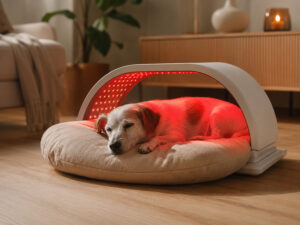
 Late at night, you come across an ad claiming that red light therapy can help ease your senior dog’s stiff joints. It sounds promising, but is it safe, does it work, and how can you tell whether the claims are reliable? Red light therapy is gaining attention in pet care, prompting dog owners across Massachusetts and beyond to look more closely at this treatment.
Understanding the available evidence, potential risks, and regulatory terminology can help you make informed decisions without being swayed by marketing claims. Before trying any new therapy, consult your veterinarian to determine whether it is appropriate for your dog.
What Is Red Light Therapy for Dogs?
Red light therapy, sometimes called photobiomodulation, uses red or near-infrared light on the skin. The idea is that light reaching tissue may help ease discomfort or support healing. Owners most often consider it for sore joints, slow-healing spots or post-surgery recovery.
Devices range from clinic equipment to handheld wands and wraps sold online. That range matters, because “red light” can mean very different tools, with different strengths and different levels of oversight.
So, Is It Safe?
The fair answer is “it depends.” Used on the right dog, with a suitable device and sensible limits, many vets consider it low risk. But safety is not automatic, and the evidence for specific benefits is still developing.
Common concerns include:
- Eye exposure, since bright light near the face can be uncomfortable or harmful
- Too much heat on the skin, especially with long sessions
- Using a device built for people, with settings that do not suit a dog
- Skipping a diagnosis and treating a problem that needs other care
Your vet can tell you whether your dog’s health history makes any of these a bigger issue.
What “FDA-Approved” Really Means for Pet Devices
Many product pages use regulatory words loosely, so it helps to know the basics. According to the U.S. Food and Drug Administration, devices intended for animal use do not need premarket approval or clearance. The agency says manufacturers and distributors are responsible for making sure these products are safe, effective and properly labeled, and that it can act if a device is misbranded or adulterated.
That page does not give a percentage or count, so there is no single number to quote. The takeaway is plain: no pre-sale review means an “FDA-approved” label on a pet device deserves a second look. The same page invites owners and vets to report problems with animal devices to the FDA.
How to Read Labels and Marketing Claims
The terms “approved,” “cleared,” and “registered” have different meanings in medical regulation and should not be used interchangeably. This distinction matters when evaluating red light therapy devices for pets. Before choosing a product, understand what its regulatory status actually means. The key point is that there’s no such thing as “FDA-approved” red light therapy for pets, so pet owners should check a device’s safety testing, intended use, and labeling rather than relying on broad marketing claims.
Whatever you read, keep a few habits:
- Treat vague words like “clinical grade” as marketing until the seller explains them
- Ask for the safety standards a product was tested against
- Be wary of urgency tactics and sweeping promises
- Prefer sellers who invite you to involve your vet
Taking a minute to question the claims protects both your dog and your wallet.
Fur, Skin and Dose: Why Dogs Are Different
A device built for human skin may not work the same way on a dog. The same page says that fur can block light and that human dose settings do not translate neatly to pets of different sizes. Dark fur and pigmented skin can also absorb more light and heat, which is another reason to ask your vet about session length and distance.
Breed, coat thickness and body size all change how light reaches the tissue. A Newfoundland and a Chihuahua need very different plans, so a one-size-fits-all setting is a red flag.
Questions to Ask Your Vet First
Before buying anything, bring a short list to your appointment:
- What is causing my dog’s discomfort, and is light therapy appropriate?
- Does my dog have a condition or medication that makes it a poor fit?
- What device, session length and schedule would you suggest?
- How will we know whether it is helping?
- Which other treatments should continue alongside it?
Your vet may also be able to offer treatment in the clinic, which lets a professional watch the dog’s response.
Signs to Stop and Call Your Vet
Watch your dog closely during and after treatment. Stop using the device and contact your veterinarian if you notice:
- Skin redness: Redness or unusual changes in the treated area.
- Heat or irritation: Skin that feels unusually warm or appears irritated.
- Restlessness: Pacing, whining, or difficulty staying comfortable.
- Avoidance: Pulling away, hiding, or resisting the device.
- Worsening symptoms: Increased pain, swelling, stiffness, or other signs that the original problem is getting worse.
Dogs cannot tell us when something feels wrong, so monitoring their body language and physical reactions is essential.
Conclusion
Red light therapy may have a place in some dogs’ care, but “safe” depends on the dog, the device and the way it is used. Remember that animal devices are not reviewed by the FDA before they are sold, so labels need a careful read. Start with your veterinarian, choose equipment built for pets, keep sessions short and supervised, and watch your dog closely. With that approach you can explore new options while keeping comfort and safety first.